When building a game world, a concept is not real just because we can describe it.
A world is not deep just because it has history.
A culture is not believable just because it has names, maps, factions, gods, and a timeline.
Those things can help. But they are not enough.
For the player, a world begins to exist when they can observe how it behaves and start understanding the rules.
People act in certain ways.
Places allow and forbid certain things.
Objects carry meaning.
Rituals repeat.
Language reveals values.
Rules shape expectations.
The world starts becoming real when the player can say:
I understand why this thing belongs here.
That is where top-down and bottom-up begin to touch
The top-down model
When creatnig words we are trying to create a mental model, we do it creating a concept model first.
it can start with a theme, a fantasy, a value, a world premise, a symbolic idea, a cultural tension, or an emotional direction.
Top-down is important because it gives the project orientation.
Without it, the work can become a pile of attractive details without any connection or relation.
A beautiful city.
A strange creature.
A cool mechanic.
An interesting ritual.
A good line of dialogue.
A mysterious object.
But if those elements do not point toward a shared structure, the player feels decoration instead of existence.
The concept is not there to explain everything.
The concept is there to create gravity.
It pulls separate details toward the same meaning.
is a gravitational model that tells every detail why it exists.
The player builds a mental model from discovering
The designer may begin with a concept, but the player does not receive the concept directly.
The player receives fragments, and the connection between those fragments forming a concept model from which players create their mental model.|
A door shape.
A repeated gesture.
A forbidden room.
A game-economy logic.
A strange greeting.
A tool carried by everyone.
A song before work.
A statue in the wrong place.
A marketplace rhythm.
A rule nobody says out loud.
From these fragments, the player constructs a mental model. He infers how the world works. This is a bottom-up understanding, intentionally constructed. The player does not need the full world bible. They need enough observable behavior to make good predictions.
If I see this object, what does it mean? If I enter this place, what kind of behavior is expected? Could I have anticipate it? If this ritual happens, what is changing? If this group speaks this way, what do they value?
A believable world is one where the player’s predictions start matching the world’s answers.
Things exist when they have relations
A game object does not fully exist because it has a mesh, a name, or a description. It exists when it has relations.
Who uses it?
Where is it found?
What is it for?
Who is forbidden to touch it?
What happens when it breaks?
Is it sacred, cheap, rare, childish, dangerous, ordinary, shameful, or prestigious?
Does it belong to work, play, war, memory, status, survival, or worship?
An object becomes deeper when it is connected to people, places, rules, and values.
A cup is only a cup in isolation.
But the same cup can become a family object, a ritual tool, a military ration, a forbidden artifact, a sign of adulthood, a symbol of exile, or a mechanic that stores heat.
Shape relations: The physical thing is only the surface. The relations make it exist.
Ritual turns concept into repeated behavior
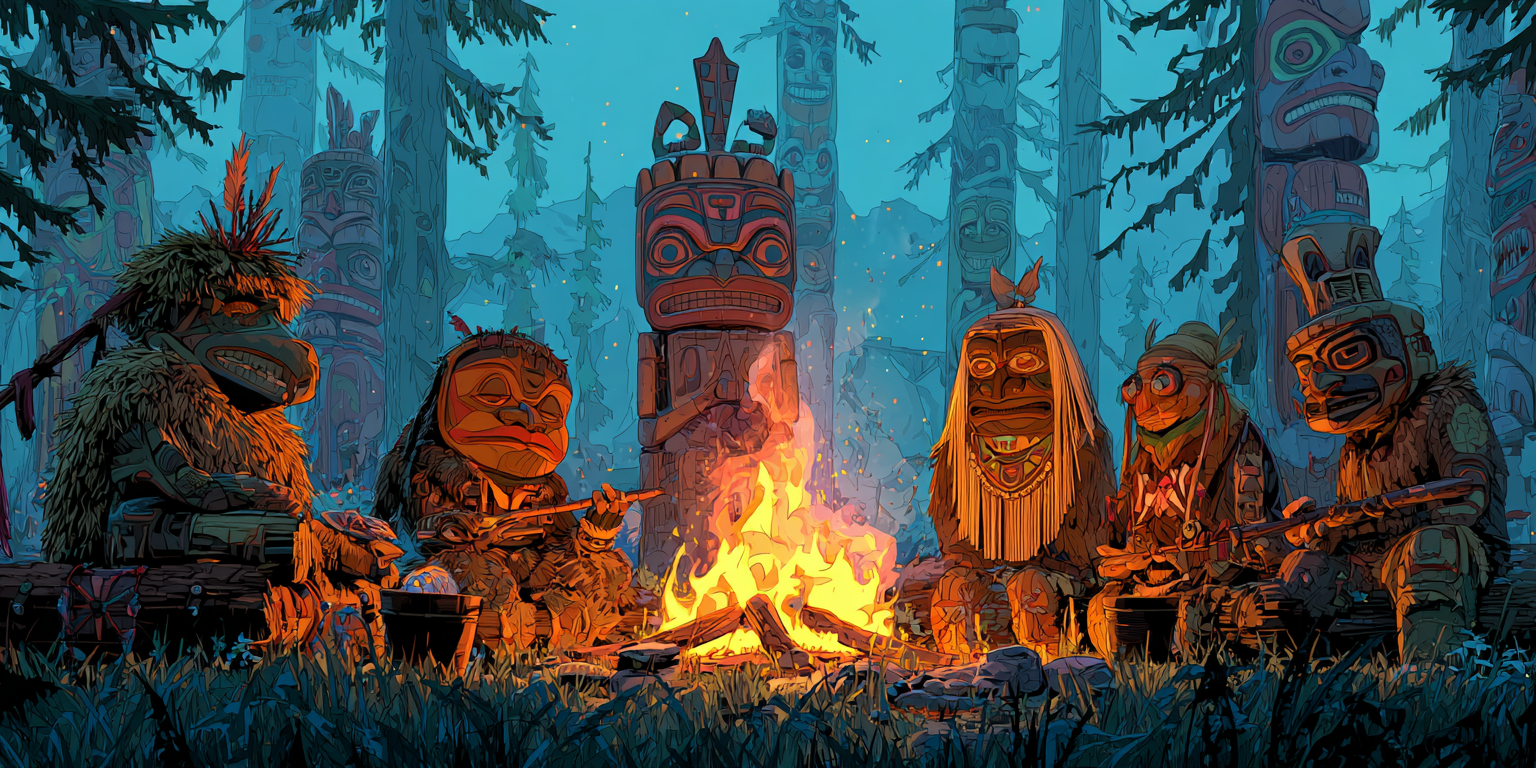
Ritual is one of the strongest ways to make a concept visible.
A ritual is a repeated action that carries meaning beyond utility.
It can be religious, social, practical, comic, political, childish, mechanical, or domestic.
The important part is repetition with meaning.
A guard changing posture when a bell rings.
A village closing windows before night.
A character touching a mask before entering combat.
A merchant refusing to sell until a greeting is performed.
A machine that must be awakened with a sequence of gestures.
A child’s game that reveals the culture’s fear.
A cooking process that teaches the player what the people value.
Ritual makes the concept behave in time.
If you have read this far, you may have noticed that all these subjects touch the surface of semiotics (which is a topic for another post). You may also have realized that everything described in the list above has one part related to meaning and another related to execution. This is top-down and bottom-up thinking in action. Everything you learn by building something occupies a space within its meaning. By connecting the meanings of your mechanics, events, signs, and feedback, you are creating culture, symbols, and language. You may not be aware of this while you are creating, so it becomes a discovery through bottom-up execution. Or you may have started with it very well defined, in which case it comes from a top-down vision.
It transforms abstract meaning into observable logical sequence.
The player does not only read that a culture believes something.
The player sees people act as if that belief is true.
That is a very different level of existence.
People, places, and things are the first triangle
When I want to make a world feel coherent, I often return to three basic anchors:
People
Places
Things
This triangle is simple, but it is powerful.
People answer:
Who lives here?
What do they need?
What do they fear?
What do they repeat?
What do they admire?
What do they avoid?
Places answer:
Where does life happen?
Where is power located?
Where is memory stored?
Where is danger contained?
Where are outsiders allowed or rejected?
Things answer:
What objects carry value?
What tools shape daily behavior?
What symbols are everywhere?
What is abundant?
What is rare?
What is ignored by locals but strange to the player?
When these three anchors are aligned, the world begins to hold.
When they contradict each other accidentally, the world becomes noise.
Ritual, references, beliefs, mood, and myth
After people, places, and things, I start looking at deeper cultural forces.
Ritual.
References.
Beliefs.
Mood.
Myth.
Language.
Values.
Attitudes.
Expectations.
Intentions.
These are not decorative lore categories.
They are design levers.
A belief changes what people consider possible.
A myth changes what people remember.
A mood changes how the same place is interpreted.
A reference changes what a symbol points to.
A language changes what distinctions matter.
A ritual changes what action means.
If the world is at war, the same marketplace behaves differently.
If water is sacred, a fountain is not just scenery.
If sleep is dangerous, night is not only a lighting condition.
If masks indicate social permission, character design becomes rule design.\
The concept becomes visible through patterns.
Direct, metaphorical, and abstract understanding
Not every idea is understood at the same distance.this is why you need a map!
The intensity you want to express every clue is also important.
Some ideas are direct.
The player sees fire and understands danger, hot, ...
Some ideas are metaphorical.
The player understands that a cracked statue can represent a broken kingdom.
Some ideas are abstract.
The player needs time, repetition, and context before the idea becomes clear.
This distinction matters because it changes how we prototype the world.
Twists are welcome to introduce imporant new concept.
A direct idea can be shown quickly.
A metaphorical idea needs a bridge.
An abstract idea needs a sequence of experiences.
If we treat an abstract idea as if it were direct, the player becomes confused.
If we overexplain a direct idea, the world becomes heavy and unnatural.
The design question is:
How far is this concept from common human understanding?
The farther it is, the more behavior the world must provide before the player can believe it.
A generic concept-model checklist
This is a generic list. When I want to test whether a concept is becoming real, I could ask:
Concept
What is the central idea of this world, mechanic, or experience?
Is it a theme, a value, a fantasy, a conflict, a feeling, or a rule? where is its place on the map?
People
Who behaves differently because this concept exists?
What do they repeat?
What do they avoid?
What do they teach children?
What do they consider normal that the player may find strange?
Places
Where does the concept become spatial?
What places are sacred, forbidden, useful, dangerous, or forgotten?
What does the layout tell the player about the society?
Things
What objects carry meaning?
What is abundant?
What is rare?
What object could not exist in another world without losing meaning?\
Ritual
What repeated action expresses the concept?
Who performs it?
When does it happen?
What changes after it is performed?
Can the player participate, interrupt, misuse, or reinterpret it?
Player understanding
Is the idea direct, metaphorical, or abstract?
What does the player understand immediately?
What must be learned through repetition?
What should remain mysterious for now?
Closing thought
Top-down gives the concept, vision.
Bottom-up gives the evidence by exploration.
A world begins to exist when both are present.
The concept gives gravity to the details.
The details prove that the concept is alive and point it toward a mental model.
Ritual is one of the bridges between them because ritual makes meaning behave.
It gives the player a visible pattern, repeated in time, attached to people, places, things, values, and consequences. Make it familiar, easy to understand, make it totally new, work more building bridges because it will require more time to the concept be understood.
a good top-down/bottom-up is when the world stops being explained.
It starts existing.